Little Print Explorers: Where Imagination Meets Intelligent Print

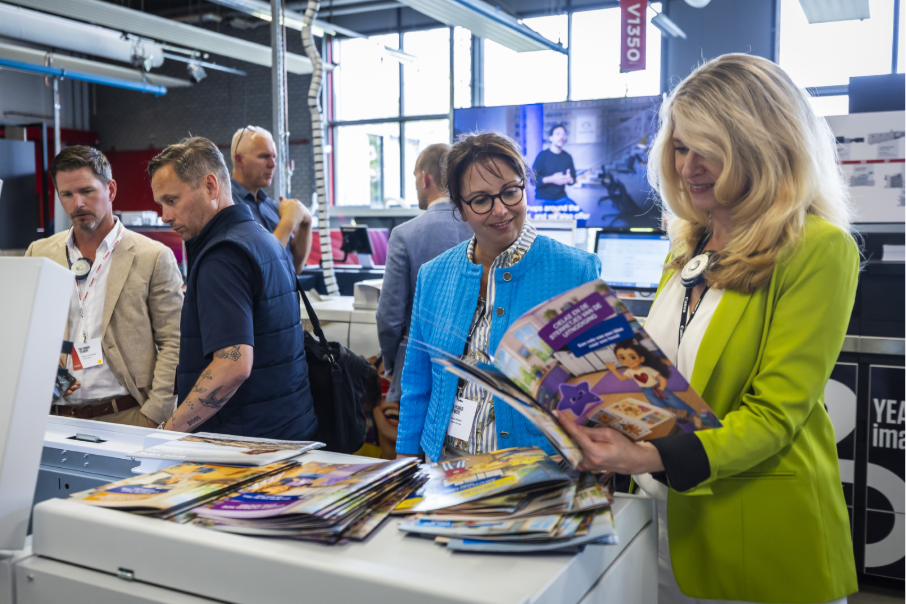
Visitors discovering personalised print at the Little Print Explorers booth at Canon Power to Move 2026, Venlo
What if a visitor could share a name and a photo, and walk away minutes later holding a personalised storybook with a unique AI-generated story and illustrations, a matching poster, postcards, and a Mini-Me standee, all printed on the spot, every single element made just for them?
That is exactly what happened at Canon’s Power to Move 2026 in Venlo. The experience was called Little Print Explorers. To visitors, it felt like magic. Behind the scenes, it was a fully automated production workflow (powered by Enfocus Switch, XMPie, and Canon) that used AI to generate unique images and storylines for every visitor, personalised and print-readied four products per person, without a single manual step.
From a Simple Idea to a Complete Print Experience
Little Print Explorers started with a straightforward ambition: show what modern print automation can really do, in a live production environment where visitors could see, touch, and take home the result.
Instead of presenting automation as a technical diagram, the project turned it into something personal. A visitor approached the stand, filled in an online form with a few details, and uploaded a photo. That was all they needed to do. From that moment, the workflow took over completely.
Behind the scenes, Enfocus Switch orchestrated the entire production chain: collecting input from the visitor, handling the uploaded image, triggering each processing step in sequence, connecting the personalisation engine, preparing print-ready files for each product, and routing every job to the right output destination. No operator had to move files manually. No one had to check whether the right data had reached the right system. Enfocus Switch handled it all automatically, consistently, and at speed.
The result was a complete set of four personalised products, each created from the same single form submission:
- A bedtime storybook with a completely unique AI-generated storyline and illustrations: the child was the main character, the story was written for them, and the images were created for them alone.
- A custom poster, designed around the same personalised visual identity.
- A set of postcards that extended the story into smaller, shareable keepsakes.
- A Mini-Me standee: a printed, cut-out character generated from the visitor’s own photo.
Within minutes of submitting the form, a visitor could hold an entire personalised print experience in their hands.
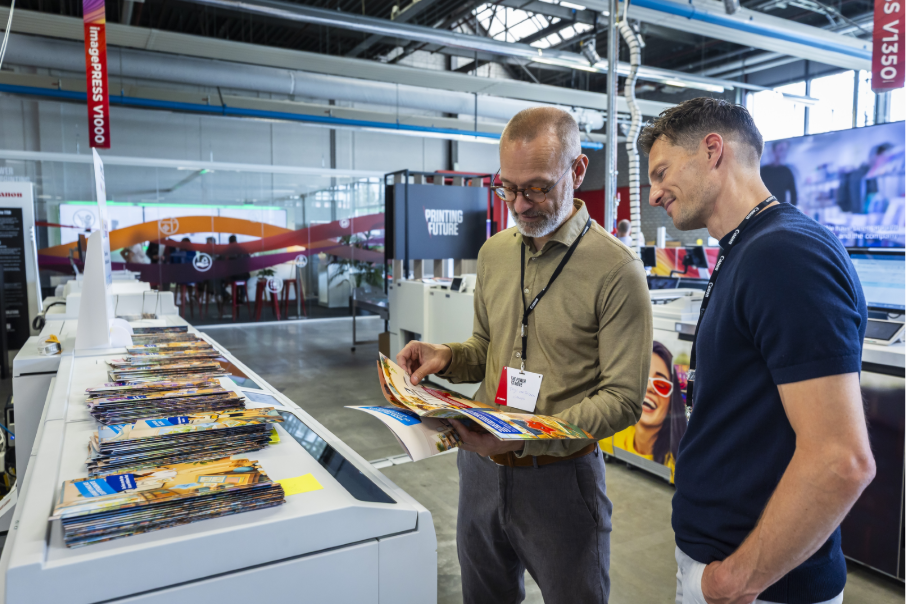
Two attendees reviewing a personalised Little Print Explorers storybook fresh off the Canon imagePRESS V1000.
Mass Customization in Action
Little Print Explorers is one of the clearest demonstrations of mass customization in the graphic arts industry that has been seen at a live event.
Mass customization sits between two production models that have traditionally been difficult to combine. Standard mass production is efficient, running thousands of identical copies drops the unit cost. Custom work is meaningful, every piece is unique and personal. The challenge has always been that combining both came at a significant cost in time, complexity, and operator effort.
Mass customization changes that equation. It makes it possible to produce large volumes of printed products efficiently, while every single piece is still unique, relevant, and personalised for the individual who receives it. The production process remains automated, repeatable, and scalable, but the output is different every time.
At Little Print Explorers, every visitor received a completely different result. The storybook had their name. The poster reflected their visual identity. The Mini-Me standee was built from their photo. No two print packages were the same. And yet the workflow that produced them was identical for every job. No custom setup, no manual intervention, no additional complexity.
Over the two-day event, that translated into 515 personalised products. Each unique. Each created from individual visitor input. Each moving through the workflow automatically.
For print service providers, this is a significant opportunity. Instead of choosing between off-the-shelf mass production and expensive bespoke work, they can now offer personalised print experiences at scale (for campaigns, events, children’s books, direct mail, photo products, promotional packaging, and more) without adding manual complexity to their operations.
Automation That Disappears
The best automation is the kind you do not notice. At Little Print Explorers, visitors were not thinking about workflows or file handling or job routing. They were excited about their personalised storybook. The automation was completely invisible, which is exactly how it should be.
Enfocus Switch acted as the central nervous system of the entire operation. It connected every component of the production chain into a single, continuous flow: the web form, the image upload, the personalisation engine, the preflight and file preparation steps, the production queue, and the output destination for each product type.
As an open automation platform, Switch does not impose a fixed production model. Instead, it connects the tools, systems, and devices that are already part of a workflow and allows them to communicate and collaborate automatically. For Little Print Explorers, that meant linking together form data, image processing, AI-assisted creative generation, variable data personalisation, file preparation, and physical print production. All in one seamless automated flow.
What would have required significant manual effort from an operator became a repeatable, reliable, hands-off process. Every visitor received the same quality, the same consistency, and the same speed, regardless of how many other jobs were running at the same time.
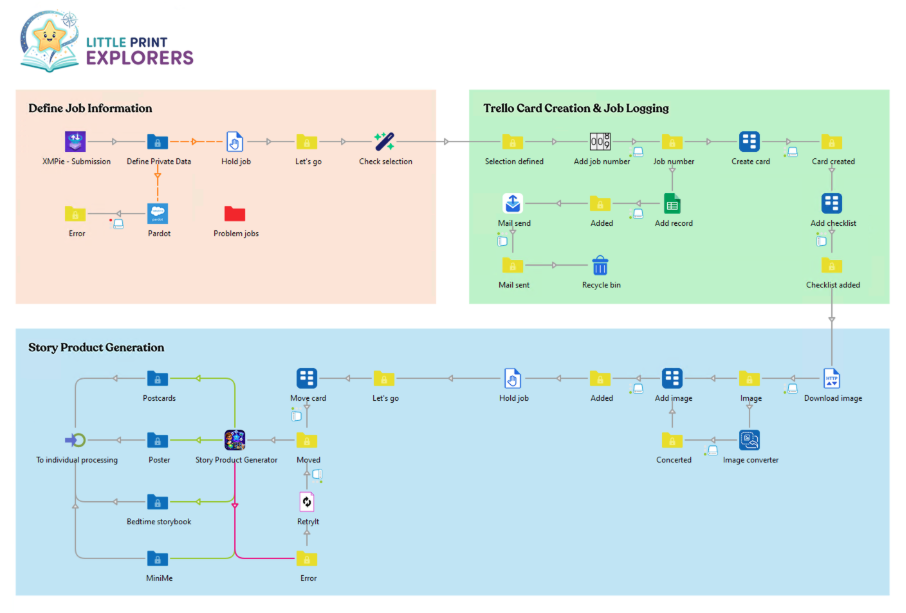
The Enfocus Switch automation workflow behind Little Print Explorers, from submission to personalised print.
AI-Generated Content: Every Product Truly Unique
Personalisation in print is often reduced to a single idea: adding someone’s name to a template. Little Print Explorers went far beyond that, generating personalised products.
Through Enfocus Switch, the workflow connected to an AI engine that created entirely new content for each visitor. The storybook did not use a fixed storyline with a name swapped in. The AI wrote a unique story for each child and generated unique illustrations to go with it. The images across the poster and postcards were also AI-generated and created fresh for that visitor, not selected from a library. No two visitors received the same story, the same images, or the same visual world.
Using XMPie, that AI-generated content was then combined with the visitor’s personal data and photo to produce four print-ready products simultaneously, each with its own layout requirements and personalisation logic, all handled automatically within the same workflow.
This is what makes Little Print Explorers genuinely different from a personalised print campaign. A campaign personalises at the data level; it changes names, addresses, and images within a fixed creative framework. Little Print Explorers personalised at the content level. The creative itself was generated uniquely for each person, meaning every visitor’s experience was theirs alone.
For print service providers, this points to a significant shift in what print can offer. When AI generation is connected to an automated production workflow, print stops being a medium that delivers a message and becomes a medium that creates something new for every recipient.
From File to Press: Where PRISMAsync Connects the Chain
A workflow is only as good as the output it produces. For the postcards and the storybook at Little Print Explorers, the final step in the Switch workflow connected directly to Canon’s PRISMAsync print server.
PRISMAsync is Canon’s own developed production platform that sits at the heart of the press; processing jobs, managing colour, monitoring print status, and controlling printer functions in real time. Rather than simply receiving a file and printing it, PRISMAsync actively senses and responds to what is happening on the device, enabling accurate colour management, precise job scheduling, and reliable output across every job in the queue.
The connection between Switch and PRISMAsync was made possible through the Canon PRISMAsync app bundle, available free on the Enfocus App Store. The app uses JMF and JDF communication to submit jobs directly from Switch to any connected PRISMAsync device, check job and device status in real time, and make dynamic decisions in the workflow based on the responses received. This tight integration meant that Switch could confirm submission, monitor progress, and respond intelligently to the status of the press throughout the run.
The result was a production chain that was not just automated at the front end, but fully connected all the way through to the output device. Print scheduling, job sequencing, and press management all happened within the same automated flow that started with a visitor uploading a photo.
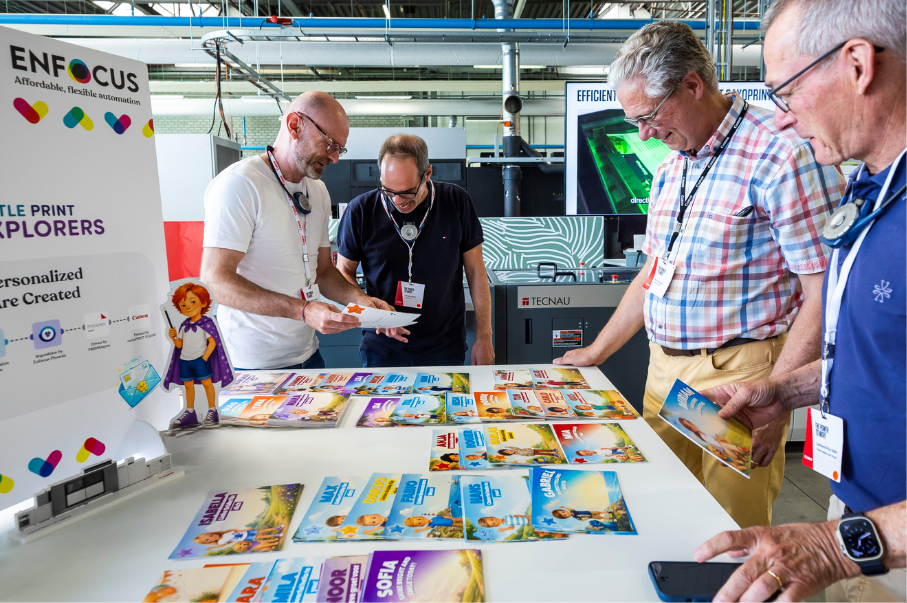
Visitors picking up their personalised postcards at Canon Power to Move 2026, Venlo.
A Showcase Built on Partnership
Projects like Little Print Explorers do not happen in isolation. They require partners who can each deliver at the highest level in their domain, and who can integrate their capabilities seamlessly with the others.
Enfocus, Canon, and XMPie each brought a distinct and essential strength to the collaboration:
- Enfocus Switch provided the automation backbone: connecting every system, managing every step, and ensuring that the entire workflow ran without manual intervention from start to finish.
- XMPie delivered the personalisation intelligence: transforming raw visitor data and images into four unique, print-ready products per person, simultaneously and automatically.
- Canon powered the production capability: with PRISMAsync managing job submission, colour, and press control for the postcards and storybook, and the Canon varioPRINT iX3200, imagePRESS V1000 and Colorado and Arizona printers delivering finished products reliably throughout the event.
What makes this collaboration valuable is not just that each partner is strong in their own area. It is that they are designed to work together. The Canon PRISMAsync app bundle is available directly from the Enfocus App Store, making the integration straightforward to set up and replicate in any Switch-based production environment.
The Future of Print Is Already Here
Little Print Explorers was not a concept. It was not a lab test. It was a live production environment where 515 unique products were made in two days. Each one personalised, each one automatically produced, each one delivered to a visitor who experienced something genuinely memorable.
For print service providers, that is the real message. The technology to offer personalised print at scale exists today. The automation platforms, the personalisation engines, the print server integration, and the production technology are all mature, proven, and ready to be connected.
The question is no longer whether this kind of production is possible. It is what you choose to do with it.